
Your Ultimate Guide to Wine Cellar Essentials in 2026: From Novice to Connoisseur

Updated: Oct 1

Full Disclosure: This guide is independently researched and written. To support our work, we may earn a small commission if you purchase through the Amazon links on this page, at no extra cost to you. We only recommend products we believe in.
This article was originally written in September 2025 and has been updated August 2026.
For every wine lover, there comes a moment. You're no longer just buying a bottle for dinner; you're buying two—one to drink and one to "put away." This is the spark. The idea of a wine cellar, a personal library of liquid history, begins to take shape. But I learned the hard way that a true cellar is more than just a collection of bottles in a dark room. It's an ecosystem, a carefully curated environment where wine doesn't just survive, but thrives. My first "cellar" was a cool basement corner, and while it was better than the kitchen rack, I quickly realized I was missing the essential tools to protect, organize, and truly enjoy my growing investment.
I've navigated the overwhelming world of gadgets, gizmos, and gear. This guide is the roadmap I wish I had. We'll demystify what a "cellar" really means in the 21st century (hint: you don't need a sprawling underground cavern) and break down the absolute essentials into three core categories: The Environment, The Organization, and The Tools. This is your definitive, expert-led guide to building a functional, beautiful, and rewarding wine cellar, piece by essential piece.
Part 1: The Environment - Forging the Perfect Haven
This is the most critical and least glamorous part of your cellar. Without the right environment, everything else is window dressing. As we detail in our foundational guide on storing wine, you are fighting a constant battle against wine's mortal enemies: heat, light, and vibration. In a true cellar, you don't just mitigate these factors—you control them with precision.
The First Pillar: Precision Temperature Control
The golden rule is a consistent 55°F (13°C). This is the ideal temperature that allows wine to evolve slowly and gracefully, developing complex secondary and tertiary notes. A dedicated cellar space, unlike a simple basement, requires a specialized cooling unit that is designed not just to chill the air, but to do so gently and maintain that exact temperature year-round, regardless of the season outside. These are not standard air conditioners; they are engineered for low noise, minimal vibration, and the specific thermal needs of a wine cellar.
Essential Cooling Unit: CellarCool CX2200 Wine Cellar Cooling System

For those building a dedicated walk-in closet or small room cellar (up to 265 cubic feet), the CellarCool CX2200 is the industry workhorse. I chose this model for my first custom cellar, and its reliability is legendary. It's a through-the-wall unit, making installation relatively straightforward for a DIYer or contractor. Unlike a window AC unit, it's engineered to maintain the crucial 55-degree setpoint with unwavering consistency. It uses a dynamic air-flow system to ensure even temperature distribution throughout the space, preventing hot spots. What's most impressive is how quietly it operates.
You get the temperature precision you need without the annoying drone of a typical compressor. It’s a significant investment, but it's the single most important piece of hardware for guaranteeing your collection's longevity and protecting your investment in the bottles themselves.
Pros | Cons |
|
|
The Second Pillar: Humidity Management
Temperature gets the spotlight, but humidity is the silent guardian of your collection. The ideal range is 60-70% humidity. Too low, and corks will dry out, shrink, and allow oxygen to seep in, destroying the wine. Too high, and you risk mold and label damage. Most cellar cooling units help manage humidity, but depending on your climate, you may need a dedicated humidifier or dehumidifier.
Essential Humidity Monitor: Govee WiFi Hygrometer Thermometer

Before you can control humidity, you must be able to measure it accurately. The Govee WiFi Hygrometer is the single most valuable essential in my entire cellar. This tiny, brilliant device provides hyper-accurate, real-time temperature and humidity readings directly to an app on your phone. You can set alerts, so if the humidity drops below 55% or the temperature spikes for any reason (like a power outage), you'll get an immediate notification.
This provides incredible peace of mind. The app also stores historical data, so you can track your cellar's stability over weeks and months. I have three of these in my cellar—one high, one low, one in the middle—to ensure there are no microclimate pockets. For under $70, there is no better investment for monitoring the health of your cellar's environment.
Pros | Cons |
|
|
Part 2: The Organization - A Library for Your Bottles
Once your environment is stable, you need to house your collection. Proper racking is about more than just aesthetics; it's about safety, stability, and maximizing your space. It also needs to work in concert with a robust inventory system so you can find that specific bottle of Merlot you're looking for without pulling out fifty others.
Essential Racking System: Wine Racks America Modular Pine Wine Rack Kit

When starting my cellar, I made the mistake of buying a small, fixed-size rack. My collection outgrew it in six months. That's why I am a passionate advocate for modular racking. Wine Racks America offers incredible kits that are like LEGOs for wine collectors. You can start with a 100-bottle kit and then add new sections, corner pieces, and display rows as your collection expands. They are made in the USA from premium pine (or redwood, for a higher cost) and are incredibly sturdy and easy to assemble.
The design ensures bottles are held at the correct slight angle to keep the corks moist. By choosing a modular system, you are future-proofing your cellar. You're not just buying a rack; you're investing in a system that can grow with you, whether you're collecting the best affordable wines or splurging on blue-chip Bordeaux.
Pros | Cons |
|
|
Essential Inventory Tool: Reusable Wine Bottle Tags

While cellar management apps like CellarTracker are indispensable for serious collectors, you still need a physical way to identify bottles without disturbing them. These simple, reusable plastic tags are a low-tech lifesaver. You can write the wine's name, vintage, and ideal drinking window on the tag with a dry-erase marker and hang it on the bottle's neck. This means you can see exactly what's in a given slot at a glance, without having to slide the bottle out, which causes vibration and can damage labels.
I use these religiously. They save me an immense amount of time and prevent unnecessary disturbance to the other aging bottles. It’s a simple, cheap essential that solves a major organizational headache. They also make a fantastic add-on to any wine-related gift, especially from our list of wine gift ideas for her.
Pros | Cons |
|
|
Part 3: The Tools - The Connoisseur's Toolkit
Your cellar is a place of storage, but it's also the launchpad for enjoyment. Having the right tools on hand to open, serve, and preserve your treasures is what elevates a cellar from a mere storage locker to a true wine sanctuary.
Essential Opener: Pulltap's Professional Waiter's Corkscrew

Forget the fancy, bulky, and often flimsy gadgets. Ask any sommelier what they use, and 99% will show you a Pulltap's or a similar double-hinged waiter's friend. This is the gold standard for a reason. The two-step hinge provides the leverage needed to extract even the most stubborn corks smoothly and vertically, without bending or breaking them. The Teflon-coated worm slides into the cork with minimal friction, and the serrated foil cutter is sharp and effective. It's a simple, elegant, and nearly indestructible piece of engineering that fits in your pocket. While lever models have their place, the control and feedback you get from a classic Pulltap's are unmatched.
It’s the first and most important tool for any wine drinker, and an absolute must-have in your cellar. If you want a deeper dive on wine terms, our wine glossary for beginners is a great place to start.
Pros | Cons |
|
|
Essential Preservation System: Coravin Timeless Three+ Wine Preservation System
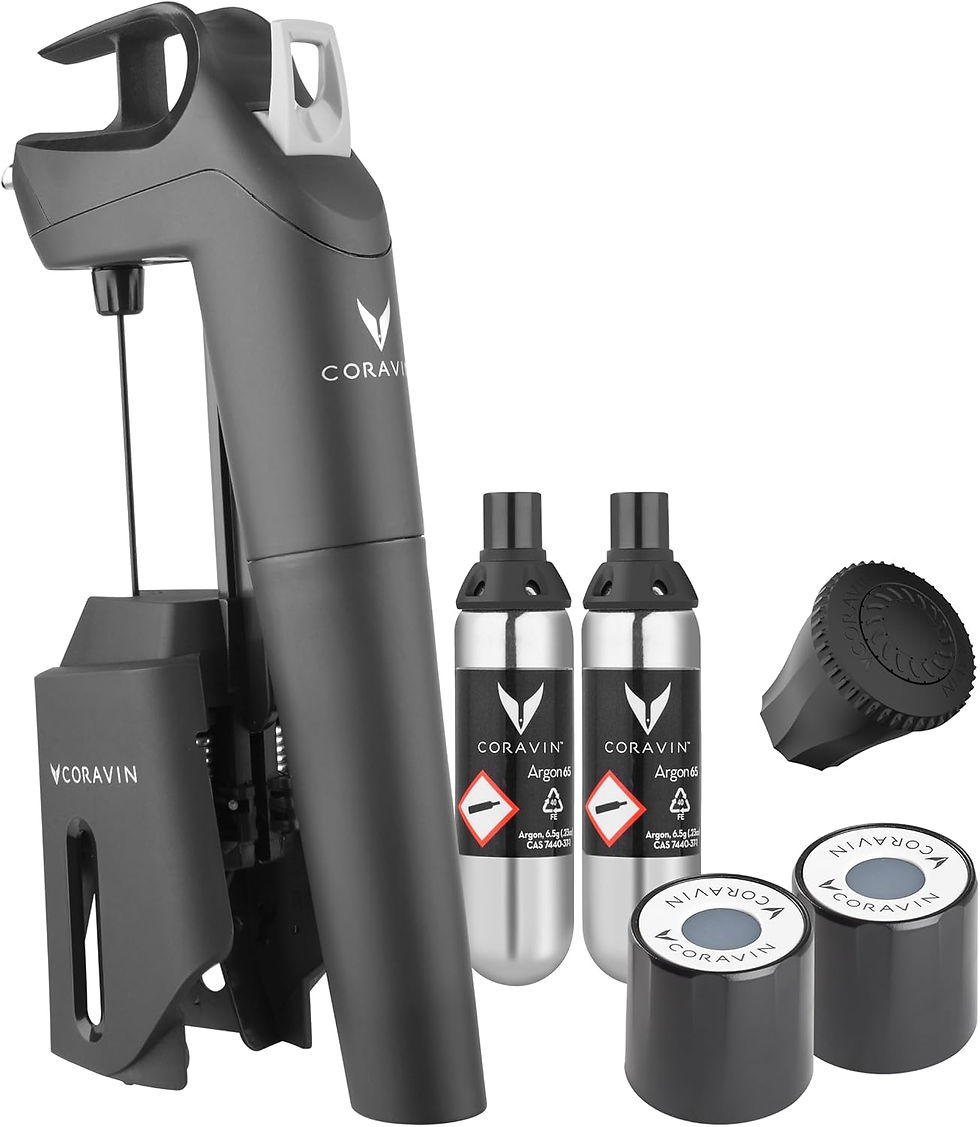
What if you want just one perfect glass from that special bottle of aged Bordeaux? Opening it means you're committed to finishing it in a day or two. The Coravin system completely changes that equation. This revolutionary device allows you to pour wine without removing the cork. It inserts a medical-grade hollow needle through the cork, pressurizes the bottle with pure, inert argon gas, and pours the wine out. When you remove the needle, the natural cork reseals itself. The argon gas, which is heavier than oxygen, forms a protective layer on the remaining wine, preventing oxidation for weeks, months, or even years.
This is not a gadget; it's a gateway to freedom. It lets you sample wines from your collection as they age, compare different vintages side-by-side, or enjoy just a single glass of your best bottle on a Tuesday. I use my Coravin constantly; it has fundamentally changed how I interact with my collection, especially with rare or organic and natural wines that I want to track over time. For a serious collector, it is an absolutely essential tool.
Pros | Cons |
|
|
Conclusion: Your Personal Legacy in a Bottle
Building a wine cellar is a deeply rewarding journey. It transforms wine from a simple beverage into a living collection of places, years, and memories. It's a commitment to patience and a celebration of craftsmanship. By investing in these essentials—by mastering the environment, perfecting your organization, and acquiring the right tools—you are creating more than just a storage space. You are creating a sanctuary for your wine, ensuring that when the perfect moment arrives, the bottle you open will be not just preserved, but perfected. From exploring the world through best wine subscription boxes to cherishing that single bottle from a special anniversary, your cellar is your personal story. May it be a long and delicious one. Cheers!
Comments